Fannie Mae’s New Condo Financing Rules Are Coming. Here’s What That Could Mean Around Naperville and Chicagoland.
August 1, 2026
If you have been looking at condos around Naperville, the western suburbs, or the broader Chicagoland market, Fannie Mae’s latest condo-financing changes deserve real attention.
On the surface, this looks like lender paperwork. In real life, it is bigger than that.
These new rules can affect whether a buyer gets approved smoothly, whether a building stays financeable, whether HOA dues start climbing, and whether a seller suddenly finds out the buyer pool is smaller than expected.
That is why this matters.
Going forward, the condo conversation is not just going to be about the buyer’s credit score and down payment. It is also going to be about whether the building itself looks financially healthy enough to pass review.
Quick snapshot
Fannie Mae’s March 2026 update includes several important condo-loan changes:
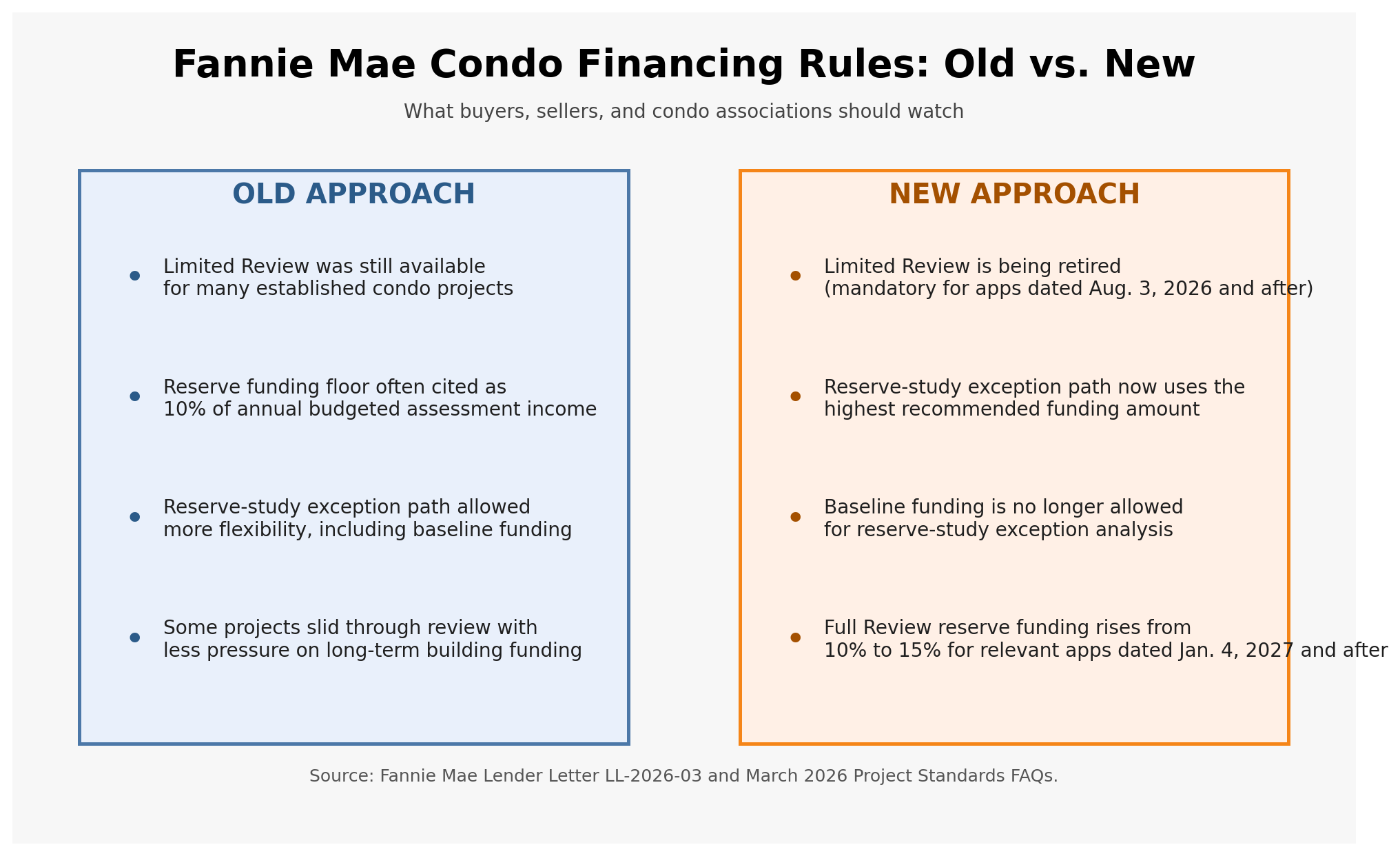
- Limited Review is being retired for condo projects.
- Some smaller condo projects may get an easier path because waiver eligibility now extends up to 10 units.
- Reserve-study standards are tightening.
- Minimum reserve funding is rising from 10% to 15% of annual budgeted assessment income for relevant Full Review projects.
- Some changes become mandatory for loan applications dated August 3, 2026 and after.
- The higher reserve-funding standard becomes mandatory for relevant applications dated January 4, 2027 and after.
What changed in plain English
Fannie Mae’s Lender Letter LL-2026-03, issued March 18, 2026, updated condo project standards and related insurance rules.
The cleanest way to explain it is this:
Fannie Mae is trying to make some parts of condo review simpler, but it is also pushing harder on whether a building is actually funded well enough to handle repairs, deferred maintenance, and long-term upkeep.
That means stronger buildings may benefit.
But weaker buildings, older buildings, or buildings that kept dues low by putting off hard decisions may feel more pressure.
1. Limited Review is going away
This is one of the biggest changes.
A lot of established condo projects used to have access to a lighter underwriting path called Limited Review. Fannie Mae is retiring that option.
That means many projects will now have to fit into either:
- Full Review, or
- Waiver of Project Review, if they qualify.
Lenders can move to that structure immediately, but they must do so for all loan applications dated on or after August 3, 2026.
For buyers and sellers, that can mean more scrutiny, more document requests, and fewer “easy” approvals in buildings that were already borderline.
2. Some small condo buildings may actually get easier treatment
This is the part that may help certain smaller projects.
Fannie Mae expanded Waiver of Project Review eligibility to include new and established condo projects with 10 or fewer units.
That could be helpful for smaller self-contained condo buildings that are otherwise clean and straightforward.
But there is an important catch:
If a project has 5 to 10 units, the waiver cannot be used if the building is part of a master association or larger development.
So a simple small building may get a smoother path.
A smaller piece of a more layered development may not.
3. Reserve rules are getting tougher
This is probably the change that will hit the average buyer and seller the hardest over time.
Fannie Mae is tightening how lenders look at reserve studies and condo budgets.
If a reserve study is being used to support the project, lenders now have to use the highest recommended reserve amount in that study. Fannie Mae also is no longer allowing the baseline funding method for that purpose.
Then comes the bigger financial shift:
Fannie Mae is increasing the required reserve allocation for capital expenditures and deferred maintenance from 10% to 15% of annual budgeted assessment income for relevant Full Review projects.
That higher standard becomes mandatory for qualifying loan applications dated January 4, 2027 and after.
Why buyers should care
For buyers, this may not show up in the headline price first. It usually shows up in the monthly reality.
A condo that looks affordable at first can feel very different once the buyer learns:
- HOA dues may need to increase,
- the building is under-reserved,
- a special assessment is coming,
- financing is taking longer,
- or certain lenders are backing away from the project.
That matters a lot around Chicagoland, where buyers are already juggling:
- mortgage rates,
- property taxes,
- HOA dues,
- insurance,
- parking costs,
- and in some buildings, older infrastructure that does not get cheaper with time.
So for the average buyer, the real question is not just “Can I afford the unit?”
It is also:
“Can I afford this building if the financial truth starts showing up in higher dues or special assessments?”
Why sellers should care
For sellers, this creates a wider gap between condos in well-run buildings and condos in buildings that have kicked the can down the road.
If a building has:
- healthy reserves,
- solid insurance,
- current records,
- no major deferred maintenance issues,
- and no ugly surprises sitting in the wings,
that can help preserve buyer confidence and keep financing options broader.
But if the building is thin on reserves or messy on documentation, sellers may feel it through:
- a smaller pool of financeable buyers,
- slower underwriting,
- more condo review questions,
- more deals needing extensions,
- or contracts falling apart late.
In practical terms, that can become price pressure.
Because if one condo in a cleaner building is easier to finance than another in a building with reserve or assessment concerns, buyers will notice.
Why this hits older Midwest condo stock differently
This is where the local angle matters.
Around Naperville, Lisle, Downers Grove, Wheaton, Lombard, Oak Brook, and many other suburban markets, condo inventory is not all shiny new construction.
A lot of projects are dealing with real-world issues like:
- aging roofs,
- balconies,
- masonry,
- parking lots,
- elevators,
- water intrusion,
- rising master insurance costs,
- and owners who are already sensitive to another bump in dues.
So when Fannie Mae pushes for stronger reserve support and a tougher review path, this can put more pressure on boards to stop underfunding the future.
That is not necessarily bad policy. But it can be uncomfortable policy.
And that discomfort often lands on buyers and sellers first.
The good news hidden in the rule change
Not every part of this is negative.
There are two real positives here:
- Some smaller condo projects may get a cleaner financing path because waiver eligibility expanded.
- Buildings that are already well-run may become more attractive because buyers and lenders will value that financial stability more clearly.
So in that sense, stronger buildings may stand out more going forward.
What buyers should ask before writing an offer
If buying a condo, especially in an older building, the questions should get a little sharper:
- Does the project have strong reserves?
- Is there a recent reserve study?
- Are dues likely to increase?
- Are there current or pending special assessments?
- Are there deferred maintenance issues?
- Has the building had insurance trouble?
- Is this the kind of project lenders are still financing cleanly?
Those questions matter just as much as the kitchen counters and floor plan.
What sellers should check before listing
If selling a condo, it helps to know early whether the building has issues that could slow financing.
That means understanding:
- the budget,
- reserve funding,
- insurance,
- any active or likely special assessments,
- and whether the building has repair issues that could spook underwriting.
The better that story is before the listing goes live, the better the odds of keeping a buyer together once lender review starts.
Bottom line
Fannie Mae’s new condo-financing rules are not just technical back-office changes.
They are part of a bigger shift toward asking whether a condo building is truly financially stable enough to support long-term ownership.
That can help healthier buildings.
But it can also expose weaker ones.
For buyers, that means looking beyond the unit.
For sellers, that means understanding the building’s financial story before the market forces the issue.
And in places around Naperville and Chicagoland, where older condo stock, insurance pressure, and HOA sensitivity are all very real, that is going to matter more than a lot of people realize.