Foreclosure Rates Are Rising Nationally. Here’s What Illinois and Naperville Look Like Right Now.
July 31, 2026
If foreclosure headlines have started popping up more often lately, there is a reason for it. Nationally, foreclosure activity moved higher in the first half of 2026, and Illinois is running above the U.S. average.
That said, the local picture around Naperville still looks more contained than what the national headlines might suggest.
This is one of those topics where the details matter. A jump in foreclosure activity does not automatically mean a wave of distressed inventory is about to hit every neighborhood the same way. For buyers, sellers, and homeowners in Naperville, the better question is this: what is happening nationally, what is happening in Illinois, and what is happening locally?
Quick snapshot
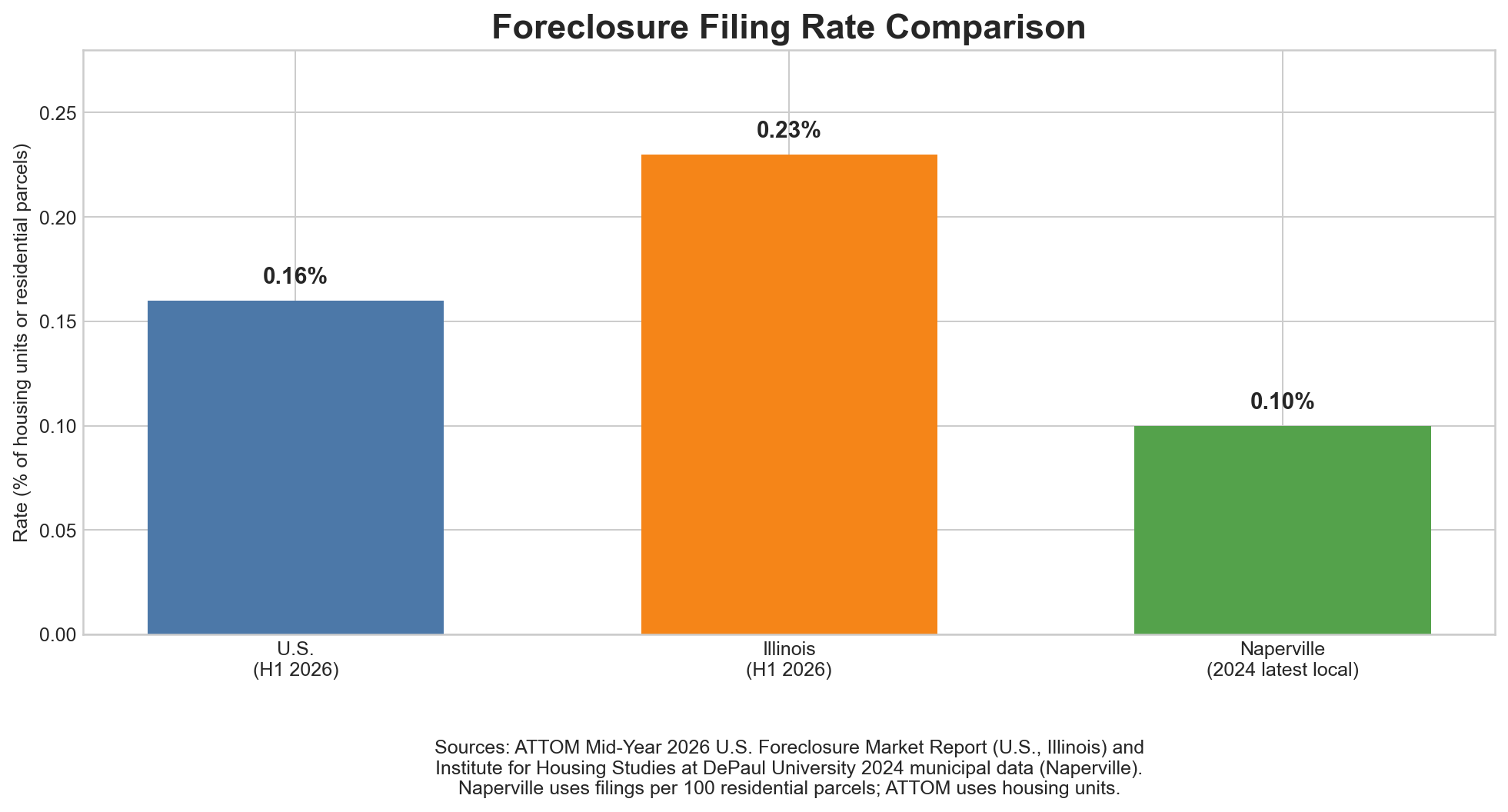
- U.S. foreclosure filing rate, first half of 2026: 0.16% of housing units, or about 1 in every 632
- Illinois foreclosure filing rate, first half of 2026: 0.23% of housing units, or about 1 in every 435
- Naperville foreclosure filing rate, latest local city data (2024): 0.10 per 100 residential parcels, or roughly 1 in every 1,000
- Illinois ranked among the five worst foreclosure-rate states in ATTOM’s mid-year 2026 report
- Naperville’s latest local rate remains below both the national and Illinois readings
Important apples-to-apples note: the national and Illinois figures come from ATTOM’s first-half 2026 foreclosure report and are measured against housing units. The Naperville figure comes from the Institute for Housing Studies at DePaul University’s latest city-level data, which currently runs through 2024 and is measured per 100 residential parcels. That makes it highly useful for local context, but not a perfect one-to-one methodology match.
What the national data is saying
According to ATTOM, 227,548 U.S. properties had a foreclosure filing in the first half of 2026. That was up 21% from the same period a year earlier.
Nationally, that worked out to a foreclosure filing on 0.16% of housing units, or about 1 in every 632 homes.
That is not the kind of number that suggests the whole market is falling apart. But it does tell us the foreclosure process is becoming more active again after a period when many owners had more equity, more pandemic-era relief, and more room to sell before falling too far behind.
In plain English: the foreclosure pipeline is moving again.
Illinois is running hotter than the national average
Illinois stands out more than the country overall.
ATTOM’s mid-year 2026 report put Illinois at 0.23%, or about 1 in every 435 housing units, which placed the state among the highest foreclosure-rate states in the country. Illinois also recorded 12,533 foreclosure filings in the first half of 2026 and 7,424 foreclosure starts.
That does not mean every Illinois market is under the same pressure. But it does mean the broader state environment is running noticeably worse than the national average.
For homeowners, that matters because distress tends to show up first in the margins:
- missed payments that turn into listings under pressure
- more price sensitivity when homes need work
- tougher outcomes for owners who waited too long to address a problem
- more uneven neighborhood-level performance
Naperville still looks more stable than the big-picture headlines
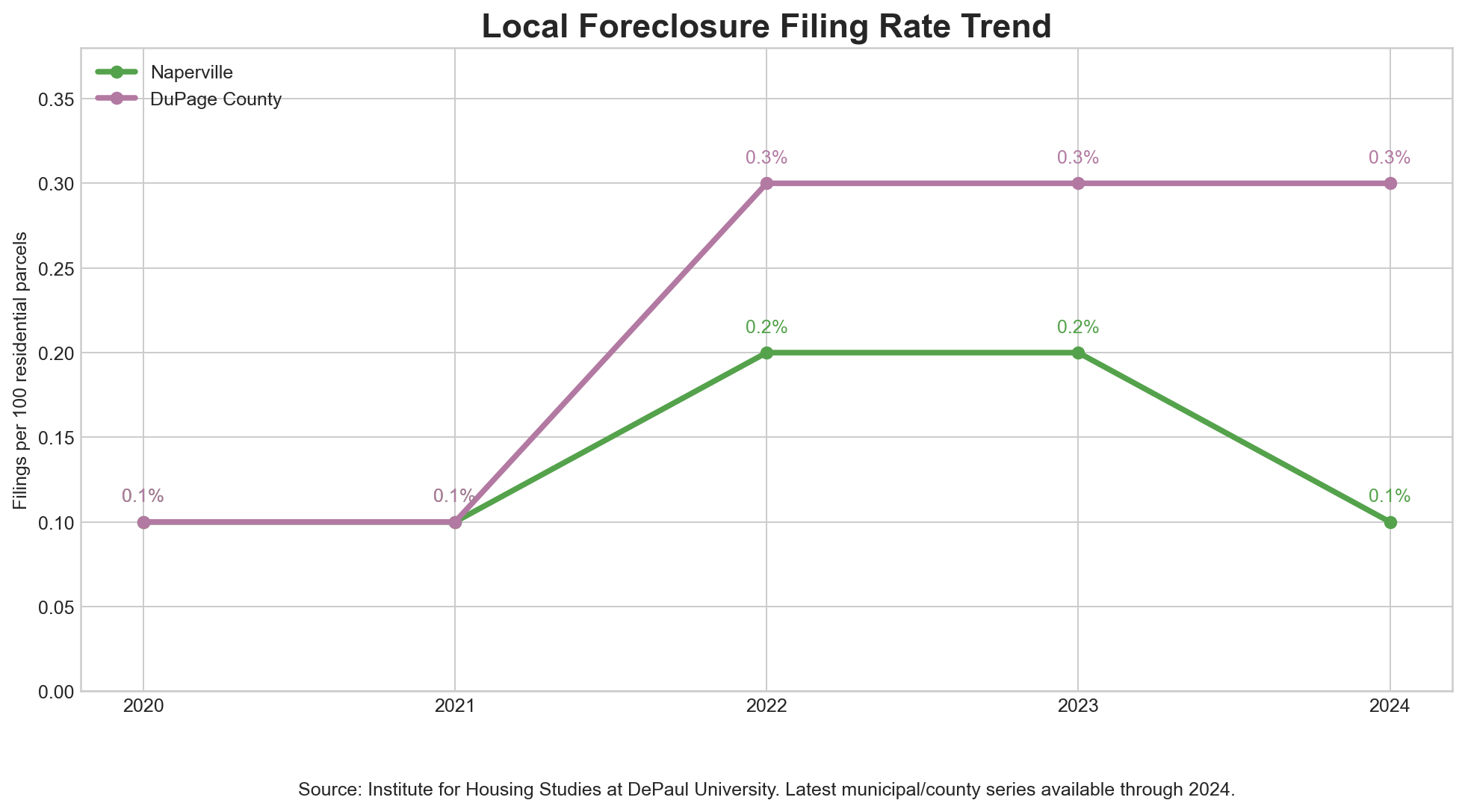
Locally, the latest city-level data available from the Institute for Housing Studies at DePaul University shows 61 foreclosure filings in Naperville in 2024, which equaled 0.10 filings per 100 residential parcels.
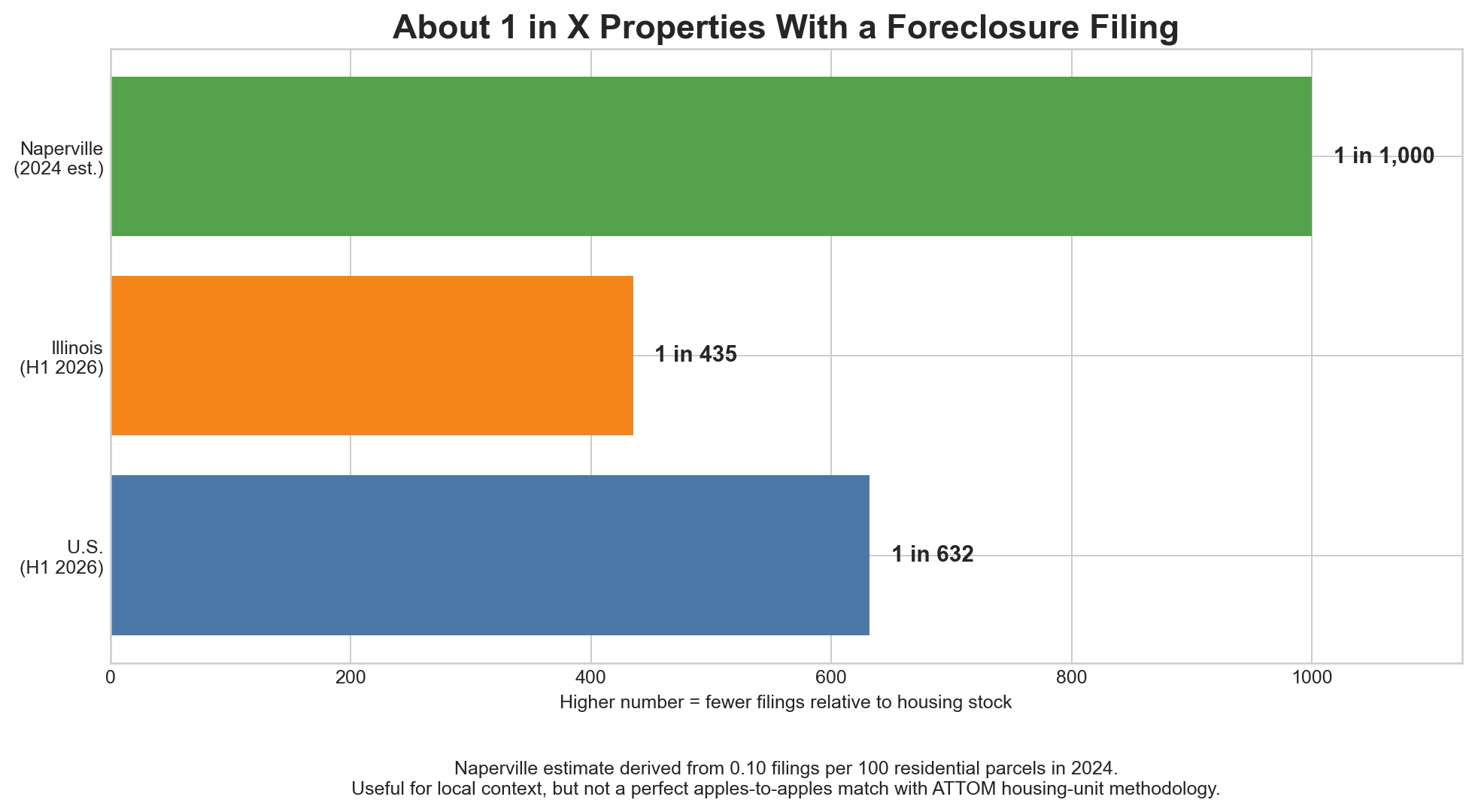
That local rate is lower than the national and Illinois readings above.
Even the broader DuPage County number came in at 0.30 filings per 100 residential parcels in 2024, which is still a more nuanced picture than a broad statewide headline would imply.
The local takeaway is not that distress is absent. It is that Naperville has still been holding up better than many other places, likely because of stronger household incomes, deeper buyer demand, and a market where homeowners often have more equity to work with before a situation turns into a foreclosure filing.
Why this matters for buyers
For buyers, rising foreclosure activity nationally and statewide does not mean there is suddenly a huge inventory of cheap homes in Naperville waiting to be scooped up.
That is usually not how this plays out in stronger suburban markets.
What it can mean instead is:
- a few more distressed or time-sensitive situations around the edges
- more variation between move-in-ready homes and homes that need updates
- slightly better leverage in certain cases where a seller has less room to wait
- more reason to watch condition, deferred maintenance, and title details carefully
If a buyer is specifically hoping for foreclosure bargains in Naperville, expectations should stay realistic. The local numbers do not point to a flood of distressed inventory.
Why this matters for sellers and homeowners
For sellers, the bigger lesson is not panic. It is preparation.
When statewide foreclosure pressure rises, buyers tend to get more selective about value. Homes that are clean, updated, and priced correctly can still perform well. Homes that show deferred maintenance or start overpriced can feel the market push back faster.
For homeowners who may be under financial strain, this is also a reminder not to wait too long. In markets like Naperville, owners often have more options than they think before foreclosure becomes the only headline.
Those options can include:
- listing earlier instead of later
- using existing equity to avoid a worse outcome
- adjusting pricing expectations quickly
- getting help before missed payments stack up
The local broker takeaway
The national foreclosure numbers are clearly moving higher, and Illinois is running worse than the U.S. average right now.
But locally, Naperville still looks more stable than the broad foreclosure story would suggest.
That is the key distinction.
If you live in Naperville or are watching the western suburbs, the smarter read is not “foreclosures are everywhere.” It is this: financial pressure is rising in parts of the market, Illinois deserves attention, and local conditions still need to be judged neighborhood by neighborhood.
If you want to talk through what these numbers mean for your block, your price range, or your selling timeline, that is where local context matters more than a national headline.