
If July felt a little tighter for buyers around Chicago, the suburbs, and the rest of the Midwest, the latest mortgage data backs that up.
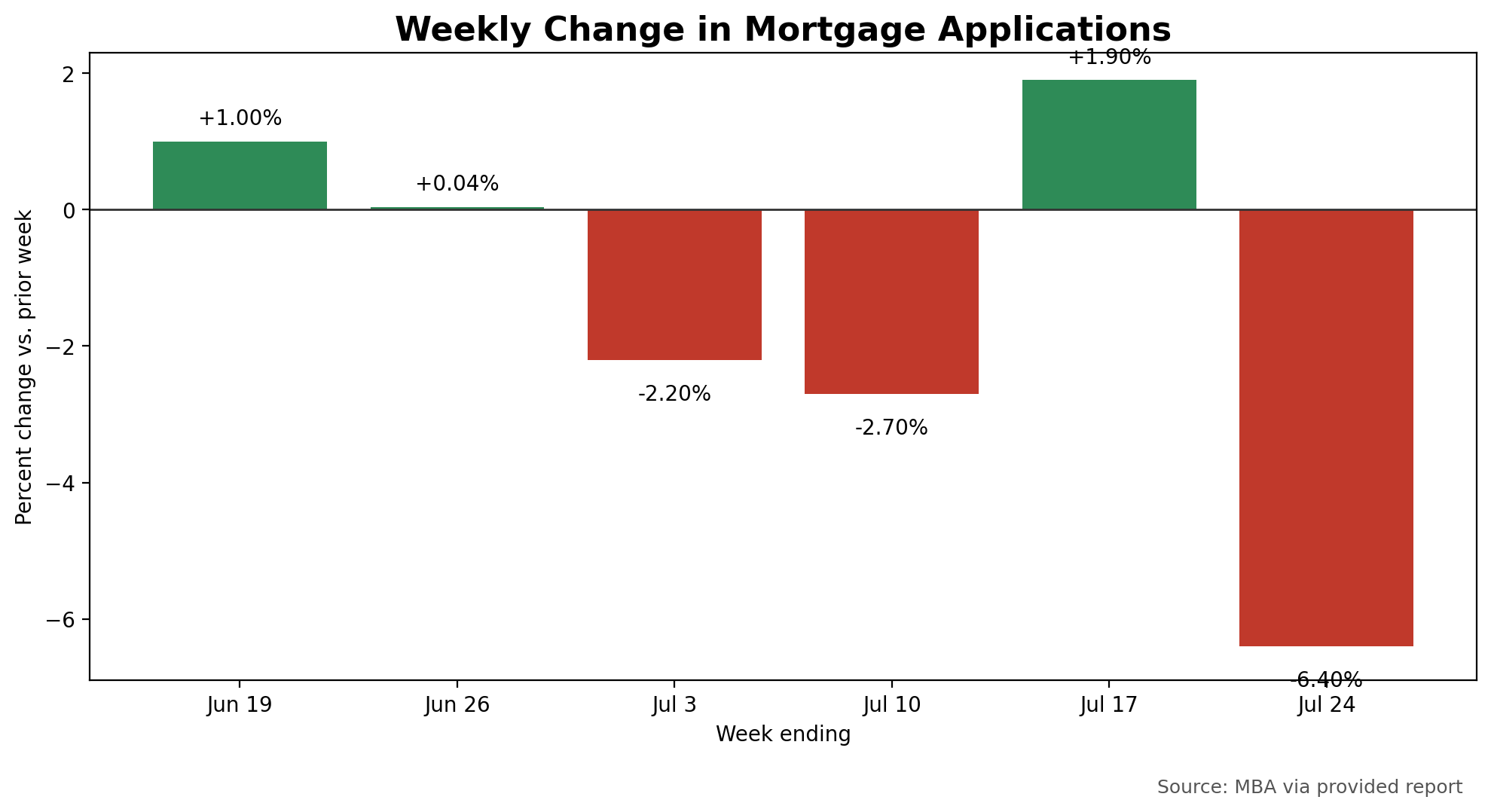
Mortgage application volume dropped 6.4% for the week ending July 24, 2026, according to the Mortgage Bankers Association. Purchase applications were down 3.6%. Refinance applications fell 9.9%.
That is a fast reaction, but it is not surprising. Buyers are still out looking. The traffic is still there. The issue is not interest in homeownership. The issue is what the monthly payment looks like once the lender, taxes, insurance, and everything else hit the page.
Quick snapshot
- Total mortgage applications: down 6.4% week over week
- Purchase applications: down 3.6%
- Refinance applications: down 9.9%
- MBA 30-year mortgage rate: 6.76%
- Freddie Mac 30-year mortgage rate: 6.58%
- 10-year Treasury yield on July 27: 4.65%
- June existing-home sales: 4.09 million annualized
- June median existing-home price: $440,600
- Existing-home inventory: 1.56 million homes
- Housing supply: 4.6 months
The MBA and Freddie Mac numbers are a little different because they track different parts of the market, but the takeaway is the same. Rates moved higher through July.
Around here, buyers are still serious. They are just more careful.
A 6.4% drop in applications does not mean buyers disappeared. It means more buyers took a second look at the numbers.
That feels very familiar in a Chicago-area market. Buyers might still want the house, the condo, the townhome, or the two-flat. They just start asking harder questions:
- What does the payment look like with today’s rate?
- What do the taxes really add?
- What happens if the HOA is higher than expected?
- How much updating can we afford after closing?
That is where deals get made or lost right now.
Refinancing has been hit even harder, which also makes sense. A lot of owners across Illinois, Indiana, and Wisconsin are sitting on mortgages from a much cheaper money era. If somebody locked in a rate in the 3s or 4s, there is usually no reason to refinance into the mid-6s unless there is another major goal involved.
Rates climbed through July
Freddie Mac showed the average 30-year fixed rate rising from 6.43% on July 2 to 6.58% on July 23.
The MBA survey came in even higher, with the average conforming 30-year rate at 6.76% for the week ending July 24.
That may not sound dramatic at first glance, but anybody shopping in Chicagoland knows a small rate move can change the conversation fast. It can push a buyer out of one neighborhood and into another. It can shift somebody from a single-family home search to condos or townhomes. It can turn a comfortable payment into a stretch.
Why rates are moving up
Mortgage rates are not moving only because of the Fed. A lot of the pressure comes from the bond market, especially the 10-year Treasury yield.
That yield moved from 4.44% on June 30 up to 4.71% on July 23, then eased back to 4.65% on July 27.
When Treasury yields go up, mortgage rates usually follow. Lenders are pricing loans off the broader cost of money, not just what is happening at the local open house that weekend.
The monthly payment is where this gets real
This is the part buyers feel immediately.
On a $400,000 30-year fixed loan, not counting taxes, insurance, HOA dues, or mortgage insurance:
- 6.00% = about $2,398 per month
- 6.58% = about $2,549 per month
- 6.76% = about $2,597 per month
That is about $199 more every month at 6.76% than at 6.00%.
And around here, that is only part of the story.
In a lot of Midwest markets, especially in parts of Illinois, buyers are not just watching principal and interest. They are also dealing with property taxes that can hit hard, older housing stock that may need work, and in some cases HOA costs that are not small. So even when the rate change looks minor on paper, the real monthly jump can feel bigger than buyers expected.
That is why more people are adjusting their search, bringing more cash, asking for credits, or stepping back to regroup.
Prices have not really backed off
Higher rates have cooled activity, but they have not caused some broad national reset.
June existing-home sales came in at a seasonally adjusted annual pace of 4.09 million, down 2.4% from May. Even with that slowdown, sales were still 2.8% higher than a year ago.
The national median existing-home price was $440,600 in June, which was 1.8% higher than a year earlier. That made 36 straight months of year-over-year price growth.
Inventory was 1.56 million homes, or about a 4.6-month supply. That is looser than the ultra-tight market we had before, but still not loose enough in many places to force broad price cuts.
For the Midwest, existing-home sales were down 3.0% month to month, but still 2.1% higher than a year ago. The Midwest median price rose 2.7% year over year to $346,600.
That sounds about right for what a lot of buyers and sellers have been feeling. The market is not frozen. It is just less forgiving.
What this means for buyers in Chicago and the Midwest
The biggest mistake buyers can make right now is looking only at list price.
The real budget is the full payment:
- principal and interest
- property taxes
- homeowners insurance
- HOA dues, if there are any
- expected repairs and upkeep
That is especially true in a market with older brick homes, vintage condos, and a lot of housing stock where inspection items can turn into real dollars fast.
A few things still help:
- Shop lenders. Rates and fees can vary more than most buyers think.
- Ask about seller credits. Sometimes a credit helps more than a price cut, especially if it helps lower the upfront cash burden or supports a buydown.
- Compare loan options carefully. Conventional, FHA, and VA can land very differently depending on the buyer and the property.
- Buy based on today’s payment. If rates improve later, great. That should be a bonus, not the plan that makes the purchase work.
What this means for sellers
Sellers still have buyers. They just have buyers who are running the numbers harder than they were a few years ago.
That means price matters more. Condition matters more. Deferred maintenance matters more. If a home needs work, buyers will price that in quickly because they do not have as much room in the monthly budget to absorb surprises.
Homes that are clean, well-prepared, and priced correctly can still move in this market. Homes that feel overpriced, tired, or too ambitious for the neighborhood tend to sit longer.
Around Chicagoland, that can be especially true when buyers are already staring at the combination of mortgage rate, taxes, insurance, and commute tradeoffs. The margin for error is just smaller now.
In some cases, a seller-paid closing-cost credit can be a very smart move, especially if it helps a buyer lower the rate or preserve cash.
Scott’s take
This still feels like a real market. It just feels more Midwest honest now.
Buyers are not chasing the dream version of the payment anymore. They are doing the math. Sellers can still do well, but the home has to be priced for the market that exists today, not for the market people remember from the cheap-money years.
The headline is the 6.4% drop in mortgage applications. The bigger point is that rates moved up, monthly costs tightened, and buyers reacted immediately.
That is exactly what we are seeing on the ground.
Source note
Data reflects information available through July 29, 2026. Mortgage rates vary by lender, borrower profile, loan type, down payment, and market conditions.